
Core Thesis: Innovation arises from a specific blend of experience, sensitivity, and judgment; its evolution depends on the ongoing link between that blend and the resulting work. Naur’s theory building applies to the theory’s origin: the architect maintains it through a tacit, shifting horizon that shapes boundaries, possibilities, and commitments. Architect and architecture coevolve via observation, projection, and action; value often lies in averted outcomes latent until needed. When the originator leaves, the organization keeps the artifact and its decisions, but coherence falters when new extensions require fresh reasoning. Sustaining innovation demands a succession of imagination: cultivating people who inherit the horizon and revise the concept.
Highlights
- An innovation expresses the experience, sensitivity, and judgment of its originator, and its capacity to evolve resides in the ongoing loop through which creator and creation shape each other.
- Following Peter Naur, a program lives through the people who hold its theory, and that theory carries a moving horizon: a largely tacit imagined future that governs present decisions.
- Much of an architecture’s value lies in the outcomes it averts, and successors often recover the original reasoning through the consequences of changing it.
- After the originator departs, the undertaking runs on accumulated coherence, and the loss surfaces years later, when it must extend past the possibilities already anticipated.
- Sustaining an innovation requires a succession of imagination: people who take part in the reasoning, come to hold the horizon, and develop the judgment to revise the conception themselves.
- Agentic development spreads the generative process across shifting arrangements of people, models, and agents, which raises the question of who holds the horizon.
Understanding Understanding

A product can die in its architect’s mind before failing in code, delivery, or the market. This happens when the original vision runs out of potential or when the architect departs, taking knowledge the organization didn’t fully grasp.
The software operates, the team produces results, and the roadmap and backlog grow while momentum continues—bringing new features, customers, and investments. For a time, the project seemed to endure its founder’s exit. Years later, the outlook may appear quite different. I’ve experienced this several times throughout my career.
I have launched organizational innovations, designed new products, set architectural paths, and gathered people around ideas that began as possibilities. Many were ambitious shifts in how an organization handled entire problem categories. They required substantial collective work, with many individuals contributing meaningfully to their growth.
What has fascinated me is what happens afterward.
Years after leaving an organization, I sometimes encounter people who still remember those projects. Occasionally, they are still working with the systems and concepts we created. More interestingly, they sometimes tell me that they have only recently come to understand why I designed something in a particular way, why I resisted an apparently attractive alternative, or why I insisted on preserving a boundary that seemed unnecessarily restrictive at the time.
Often, that understanding has come through experience. They changed something, encountered consequences, and eventually rediscovered the reasoning behind a decision made years earlier.
There is something unusual about that. The organization retained the architecture. The reasoning that generated it had become progressively less accessible. And with each passing year, the people maintaining the system were increasingly required to reconstruct that reasoning from the consequences of their own decisions.
This led me to consider whether we misinterpret what an organization gains when an innovation is developed.
We often view innovation through its outward form. It might appear as a product, software system, framework, methodology, set of abstractions, or a new business capability. Such items can be demonstrated, documented, funded, transferred, maintained, and ultimately sold. Yet every genuinely original conception has an origin. It emerged from a particular person, or a small group of people, at a particular moment, under particular circumstances. Its existence reflects a convergence of experience, imagination, judgment, curiosity, personal history, and opportunity.
The resulting innovation is an expression of that convergence. And I suspect that much of what makes an innovation capable of evolving continues to reside in the configuration that originally generated it.
The theory that gives a program life

In 1985, Peter Naur published an essay titled Programming as Theory Building, in which he offered a remarkably similar account of the relationship between software and the people who create it.
Naur argued that programming involves the development of a theory through which programmers understand how a computer program relates to the world it is intended to serve.
That theory encompasses the reasoning behind the program’s structure, the significance of its abstractions, and the ability to recognize how new requirements can be accommodated within the existing conception.
In one example, Naur describes a compiler developed by one team and subsequently extended by another. The successor team had access to extensive documentation and personal advice from the original developers. Nevertheless, they repeatedly proposed modifications that neglected capabilities already inherent in the design.
The original developers could quickly spot issues and propose simpler fixes. Years later, after modifications by disconnected programmers, the compiler’s once-strong structure was obscured by additions. The architecture remained recognizable but lost much coherence. This closely resembles what I have observed across my career.
And Naur went considerably further. In a section titled Program Life, Death, and Revival, he proposed that a program’s life relies on ongoing involvement from people who hold its theory. He characterized a program’s death as taking place when the team carrying that theory breaks apart. The program might continue executing successfully for years. Its condition would become apparent when new requirements could no longer be accommodated intelligently.
Revival, in Naur’s account, required another team to develop an adequate theory of the program, a process that could be difficult, expensive, and sometimes less worthwhile than starting again. More than forty years later, I find myself arriving at a similar conclusion through my own experiences. But I think there is another dimension worth exploring.
Where does the theory itself come from? What is it about a particular individual, their experiences, sensitivities, imagination, and judgment, that allows them to conceive an innovation in the first place? And what happens to that generative capacity as the creator and the creation evolve together?
These questions guide us toward a point I consider central to architecture.
The idea is an expression of its creator

Consider how an architect arrives at an original idea.
They bring everything they have experienced into the encounter with a problem. Decades of successes and failures, technologies that inspired them, abstractions that disappointed them, organizations they have worked within, people they have learned from, and systems they have seen succeed or collapse. They bring particular sensitivities. One architect may be unusually attentive to coupling and dependency. Another may have an exceptional feel for concurrency, temporal behavior, or the relationship between conceptual models and operational reality. Someone else may recognize organizational or commercial possibilities that remain invisible to those around them.
Each possesses a distinctive way of attending to the world.
And the relationships between these experiences and sensitivities matter enormously. An idea may emerge because someone sees a connection between two domains that nobody else had thought to bring together. An abstraction may arise from a frustration that has been accumulating for twenty years. A design principle may reflect the remembered consequences of a failure encountered in an entirely different industry.
Much of this knowledge is tacit. Some of it is intuitive. Some is so deeply embedded in the individual’s thinking that even they may struggle to explain precisely how they arrived at a particular judgment.
Sometimes an experienced architect looks at a proposal and immediately senses that something is wrong. They may need hours to articulate the problem, perhaps days to explain its implications convincingly. The recognition itself may have occurred almost instantaneously. This is accumulated experience becoming judgment.
Naur, drawing upon Gilbert Ryle, emphasized the importance of recognizing similarities between situations and knowing how a theory applies to the world. Such recognition is central to the intelligent modification of software.
Now imagine that same cognitive configuration encountering an opportunity to create something new. The resulting idea carries the imprint of the person who conceived it. Their particular way of seeing the problem shapes the boundaries they establish, the abstractions they choose, the possibilities they preserve, and the futures they imagine.
Two architects of comparable expertise, provided with identical constraints and resources, may generate markedly distinct systems. Each individual contributes a unique professional background to the creative process.
There is something almost biological about this relationship. We can think of the creator’s cognitive configuration as a kind of intellectual DNA. The metaphor has its limitations, since human thought is continually changing through learning, experience, and interaction. Yet it captures something important about the individuality of origins.
The original idea reflects traits of its maker that can shape its growth over many years. As the concept evolves, a more compelling shift occurs. The creator starts to transform through the act of building it.
The horizon that keeps moving
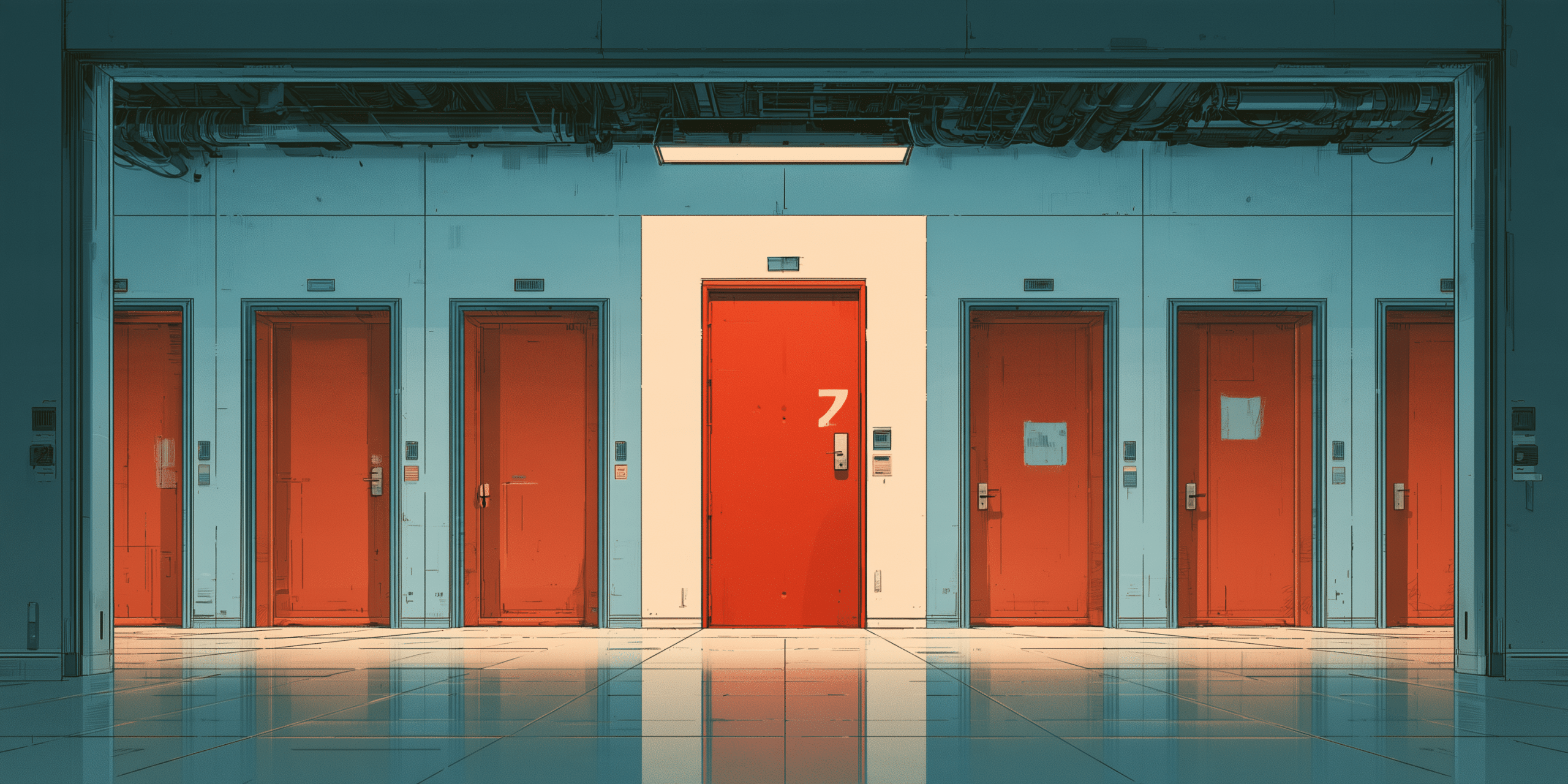
In my experience with genuine innovation, the initial concept rarely manifests as a fully defined objective; rather, it typically appears as a distant horizon. I can see enough of what might be possible to begin. I have some sense of how the different pieces might eventually fit together. There are capabilities I anticipate needing, abstractions whose importance I can already recognize, and possibilities I want to preserve even though I cannot yet describe precisely how they will be realized. Other possibilities remain vague. Some are little more than intuitions.
I occasionally conceptualize this as a sequence of doors positioned ahead of me.
I have no way of knowing precisely what lies behind every door. I cannot explore every possibility, and I certainly lack the resources to pursue them all. But I have some sense of which doors may eventually matter, which might lead somewhere interesting, and which decisions in the present could prevent me from ever reaching them.
That awareness influences the architecture from the beginning. It determines what I choose to make explicit, what I deliberately leave open, which constraints I impose, and which compromises I am prepared to accept.
Sometimes I resist a seemingly convenient choice because I can already feel how it might limit something I could want years ahead. I may find it hard to describe that future need since it is still forming. Even so, I can see that today’s proposal could make it far more difficult to handle.
Of course, keeping every possible door open would be prohibitively expensive. Architecture requires commitment. Abstractions have costs, and unnecessary flexibility can become a burden in its own right. Experience informs which possibilities deserve preserving and which can reasonably be abandoned. This is where architectural judgment becomes particularly difficult to transfer. The architect is making decisions in relation to an imagined future that may exist only partially in their own understanding. And the horizon moves.
As the system develops, I learn more about the problem. Working with other people changes my understanding. New requirements reveal relationships I had overlooked. Technical experiments expose unexpected opportunities. Sometimes an assumption that seemed fundamental becomes unnecessary. Occasionally, the entire conception needs reconsideration. The architect and the architecture evolve together.
There is another aspect of this process that I find difficult to describe.
When I imagine the future of something I’m creating, I often experience it as though I’ve already arrived there. I imagine working within that future system, encountering situations it will need to accommodate, seeing how its parts relate, and considering what it might make possible for those using it. Then I return to the present and begin working out how to get there. The future is influencing decisions long before it can be fully specified.
Many seasoned architects likely recognize a version of this process. It feels like mental simulation, shaped by experience and an openness to possibilities that have not yet become requirements. Yet it remains fallible. The imagined future might prove unrealistic, or circumstances could shift. Others may notice possibilities the original architect missed. The value rests partly in continually revising that vision through engagement with the world.
Over time, the architect develops a particular sensitivity to the undertaking. They recognize subtle changes in direction, emerging threats to coherence, and opportunities that may be invisible to someone encountering the system for the first time. Some of that understanding becomes embedded in documentation, architectural decisions, and code. Much of it remains in the evolving relationship between the creator and the creation.
The horizon is seldom documented with its full complexity; indeed, such a representation may be unattainable.
Some possibilities remain unstated. Others appear as faint intuitions, waiting for situations that might bring them into focus. Certain limits endure from experiences the architect no longer recalls. After several years of developing an ambitious product, its creator gathers a history of insight tied to the process.
That history becomes significant when another person is asked to assume control.
The car is still moving

Imagine a group of people embarking on a long journey. One person recognizes a destination worth pursuing. They persuade others to come along, choose a vehicle, start the engine, and begin driving. As the journey progresses, everyone contributes. Some help navigate. Others maintain the vehicle, suggest alternative routes, identify opportunities, or challenge the direction being taken. The journey becomes a genuinely collective undertaking.
The driver is continually learning.
They discover which roads are difficult, which routes are promising, where the vehicle performs well, and where it is likely to encounter problems. They become familiar with the landscape. They anticipate bends before they appear and adjust their driving according to conditions that others may barely notice.
Over time, the destination itself may change. What began as a relatively modest journey becomes an exploration of possibilities that nobody could have fully imagined when the engine was first started.
Then, somewhere along the road, the driver leaves.
Perhaps they choose to leave. Perhaps they are pushed out. Perhaps the organization simply decides that the journey has progressed far enough for someone else to take responsibility. The car is still moving.
The remaining passengers can view the road, manage the controls, and grasp the vehicle. Some might be skilled drivers themselves. There is ample reason to expect the journey to continue. Yet they inherit a path whose history they have only partly known. They may know the next destination on the route. They may understand the current speed and direction. They may even hold a map showing the roads the original driver planned to use. Their grasp of why the trip unfolded as it did, and how the destination was repeatedly revised, is necessarily different.
The organization observes that the car continues moving. The passengers remain aboard. The next milestone is approaching. And so the transition appears successful. What may escape attention is how much of that movement is still drawing upon the decisions, relationships, and accumulated judgment of the person who has departed.
The original conception continues to provide coherence. Earlier architectural choices continue to accommodate change. Boundaries established years before continue preventing problems that nobody is consciously thinking about.
A successful architecture can sustain an undertaking for a remarkably long time through the quality of decisions already made. That accumulated capacity makes the consequences of losing its originator unusually difficult to recognize. The real test comes when the inherited understanding no longer provides sufficient guidance, when the organization encounters a situation requiring it to extend or fundamentally reconsider the original conception.
By then, the original driver may have been gone for years.
The knowledge embedded in what was avoided

A compelling aspect of architectural experience is the extent to which its value derives from decisions that preemptively avert undesirable outcomes.
An architect may reject an apparently elegant abstraction because they recognize how it will behave under conditions that have yet to arise. They may insist on a particular separation of responsibilities because they anticipate a future requirement. They may resist a shortcut because they have already experienced its consequences elsewhere.
The value of these decisions can remain invisible for years. A boundary designed to prevent coupling may yield no discernible event. A purposefully constrained interface can appear unnecessarily restrictive. An abstraction intended to preserve future flexibility may seem excessive relative to current requirements. Successors may inherit the resulting structure without fully understanding the conditions that informed its design. They change something.
At first, the change seems good, simplifying an implementation, removing an awkward constraint, or speeding delivery. Months later, an unexpected dependency appears. A formerly straightforward extension grows difficult. A requirement reveals a structural limit that the original design had aimed to prevent. Then, an old choice starts to make sense.
Years later, former colleagues recall my once-questioned decisions, later validated by events. The system held knowledge in choices detached from their original rationale; the organization had to rediscover it through experience.
Sometimes the consequences were manageable. Sometimes the system had already moved sufficiently far in another direction that recovering the earlier coherence became difficult. What makes this especially significant is that architectural foresight is frequently concerned with circumstances that may never arise while the original architect remains involved. The absence of a problem can itself be the consequence of a decision made years before.
How does an organization gauge the worth of such an outcome? How does it identify what was avoided? And how does it convey that insight to someone who has not yet faced the conditions requiring the choice?
Naur recognized this difficulty. He observed that several implementations of a requested modification might all produce correct behavior, while only some remain consistent with the underlying theory of the program.
Long-term outcomes are contingent upon the alignment between changes and the conceptual framework underpinning the program’s architecture. This dynamic accounts for architectural degradation resulting from a sequence of ostensibly rational decisions. As the original rationale becomes less discernible, incremental changes accumulate. Successive layers emerge to mitigate constraints introduced by prior iterations. Structural boundaries lose coherence, and interdependencies proliferate. Consequently, greater effort is required to maintain existing functionality, and modifications that were once simple become increasingly complex.
There is an entropic quality to this deterioration. The architecture is exposed to a continuous stream of competing pressures, each requiring interpretation and adjustment. Maintaining coherence demands an equally continuous capacity to recognize their significance and respond. Where that capacity weakens, the system gradually becomes a record of accumulated accommodations. By the time the consequences appear in delivery schedules, operational complexity, or commercial performance, the loss of architectural direction may be a distant organizational memory.
When the feedback loop is broken
I believe the most significant aspect of this relationship is its cyclical nature.
The creator generates an idea from a particular cognitive configuration. The idea becomes an undertaking. The undertaking produces experiences that change the creator. Those changes influence subsequent architectural decisions, which change the undertaking, which then changes the creator again.
The process becomes a continuous feedback loop. The architect is observing the system, interpreting emerging situations, projecting possible developments, and acting upon those projections. The consequences of those actions become part of their accumulated understanding. Over time, the architect becomes increasingly attuned to the particular undertaking they have helped create. When the originator leaves, that feedback loop is interrupted.
The organization retains the software, accumulated decisions, and distributed knowledge among its staff. Its capacity for coherent evolution now depends on the relationships that subsequent participants establish with the initiative.
A new architect brings fresh perspective and potential, but cannot instantly inherit accumulated insight. Their value emerges through experience and participation; replacing the original architect is problematic because expertise alone cannot replicate years of innovation. Until a new generative relationship forms, the product depends on past capacity.
The succession of imagination

There is an obvious danger in taking this argument too far. Innovation can easily become surrounded by myths of exceptional individuals. The visionary founder, the genius architect, the irreplaceable leader whose departure supposedly explains everything that happens afterward. Reality is considerably richer.
Most ideas are collaborative from the start; even individual innovations rely on colleagues, feedback, technology, and circumstance. While originators may provide the spark, others often ensure viability. Some originators cling to flawed concepts, resisting change and confusing preference with principle long after their ideas are obsolete.
Some innovations deserve to fail quickly. Some products improve enormously when their founders step aside.
My concern is with a particular situation: an undertaking that has demonstrated genuine potential, developed a coherent direction, attracted committed participants, and begun producing something valuable through the continuing guidance of its originator. In such cases, the creator may serve as an integrative center for the collective.
They spot potential in others’ work, link seemingly unrelated ideas, and ensure coherence across teams while adjusting the long-term vision as projects evolve. Their ability to unify diverse imagination into a coherent whole is rare—and organizations often struggle to recognize, develop, and retain it.
Most succession planning concerns the transfer of responsibilities. Someone takes ownership of the roadmap. Another becomes responsible for architectural decisions. Technical knowledge is documented, processes are established, and the remaining team absorbs the departing individual’s work. Sustaining an ambitious innovation requires continuity in the capacity to imagine and guide its future. That takes a different kind of preparation.
A successor needs to participate in the reasoning that shapes the undertaking. They need to experience the difficult decisions, the rejected alternatives, the moments when the original conception is challenged, and the occasions when an unexpected insight changes the direction. They need opportunities to develop their own understanding of the horizon, to challenge the originator’s assumptions, and eventually to revise the conception independently.
The originator also has a responsibility to make this possible.
Centralizing decisions can breed dependency; passion may hinder shared ownership. The belief that only the creator understands the work is sometimes true but often becomes a self-imposed limit.
Lasting innovations emerge when generative power spreads among individuals deeply connected to the work—not just from long collaboration. Implementing versus designing yields distinct insights.
Successful succession requires the deliberate cultivation of people capable of continuing the intellectual work through which the innovation evolves. It requires continuity of imagination, judgment, and architectural stewardship.
When the future walks out the door
I started with the idea that a product might fail in its architect’s mind before the company notices the collapse. I suspect there is another version of this pattern. An ambitious project can start to fade when the person who has kept envisioning its future leaves the organization. The exit may seem completely routine: a resignation, a reorganization, a contract ending, a management disagreement, or a choice that the effort has matured enough to proceed under new leadership. The code stays. The staff stays. The budget may stay. For a while, the movement continues.
The consequences emerge later, when the undertaking needs to move beyond the possibilities already anticipated and discover a new direction. It is then that the organization discovers whether it has retained the capacity to generate the coherence upon which the innovation originally depended.
The originator might have held that capacity in a shape no one fully grasped, not even the originator. Their specific history, experiences, sensitivities, judgments, and connections had yielded something valuable. Over years of ongoing involvement, those abilities grew more closely linked to the project.
No single document may have captured their understanding, since much of it lay in ongoing recognition and response. No clear endpoint may have been defined, because the goal shifted as the journey progressed. No sudden alert may have signaled the loss of that ability, because the structure still drew on prior investment.
The company that loses such a person can assess the work they leave behind. It can examine the product, measure its performance, estimate its commercial value, and appoint people to maintain and extend it. What it cannot easily assess is the value of the decisions that person would have made tomorrow, the opportunities they might have recognized next year, or the reconceptualizations that might have transformed the undertaking five years later.
Those possibilities disappear without ever becoming observable losses.
Nobody can know exactly what would have happened had the original architect remained. The alternative history is inaccessible. Yet organizations routinely make decisions about the future of innovations while possessing only a partial understanding of the capabilities that made those innovations possible.
Perhaps this is one of the most important and least appreciated responsibilities of architectural leadership: maintaining the relationship between what an undertaking has become and what it might still become. That relationship is embodied in people, developed through participation, and sustained through an evolving process of creation. And when it disappears, the loss can precede every conventional indication of failure.
The engine is still running. The wheels are still turning. The passengers are still discussing the next milestone. The car continues down the road. But somewhere along the journey, the person who understood why it started, who helped others believe in where it might go, and who had been continually learning how to get there, has stepped out.
The organization may mistake that continued movement for evidence that nothing essential has been lost.
An emerging question

Yet a fresh complication affects this forty-year-old issue. We are moving into a time when software is increasingly designed, planned, and built through shifting arrangements of people, language models, coding agents, instructions, and gathered context. A person may now produce an ambitious product with limited direct involvement in its execution. Architectural choices can arise across hundreds of agent exchanges, each holding a distinct view of the task. The models shift. The plans shift. Context is condensed or lost. New agents take on choices made by earlier ones. The product keeps expanding. This prompts a question Peter Naur could hardly have expected in 1985.
What happens when the generative process responsible for an innovation continually changes, and no single participant necessarily possesses the theory that gives it coherence?
Perhaps the most significant architectural shift in the agentic era will unfold without anyone exiting the building. The individual who began the process may remain present. Agents might continue generating code. The software could keep operating. Yet the arrangement that first guided the project may have quietly vanished.
This leaves us with a question for another essay.
Who holds the horizon when the architect is no longer a single, continuous participant in the creation of software?