
Whenever we encounter a phenomenon, there seem to be two fundamentally different ways of thinking about it.
One is in terms of operations.
What happened?
What moved?
What called what?
What sequence of activities took place?
Operations describe mechanisms. They explain how something works. They can always be decomposed into smaller operations, each of which can be decomposed again. Every task becomes a collection of subtasks. Every mechanism reveals another mechanism beneath it. There is almost no natural stopping point.
The other way is in terms of outcomes.
Did it work?
Is it safe?
Is it healthy?
Will it survive?
Outcomes tell us what happens, not how it happens. They’re also judgments, showing us if something really matters.
Intelligent living systems, like humans, contrary to what many software system engineers might think, seem to devote a relatively small part of their lives to direct reasoning about their actions. For instance, when driving a car, we consciously don’t think about the complex mechanisms of pistons, fuel injection, combustion cycles, or gear ratios. Instead, we focus solely on the goal of arriving safely. Similarly, when climbing a familiar staircase, we consciously calculate the mechanics of each step. Instead, we rely on our expectation that the next step will be there. Despite our lack of comprehension of radio protocols, operating systems, or semiconductor physics, we navigate through smartphone devices without the need for explicit understanding. Instead, we rely on the expected outcomes and intuitive guidance provided by the technology.
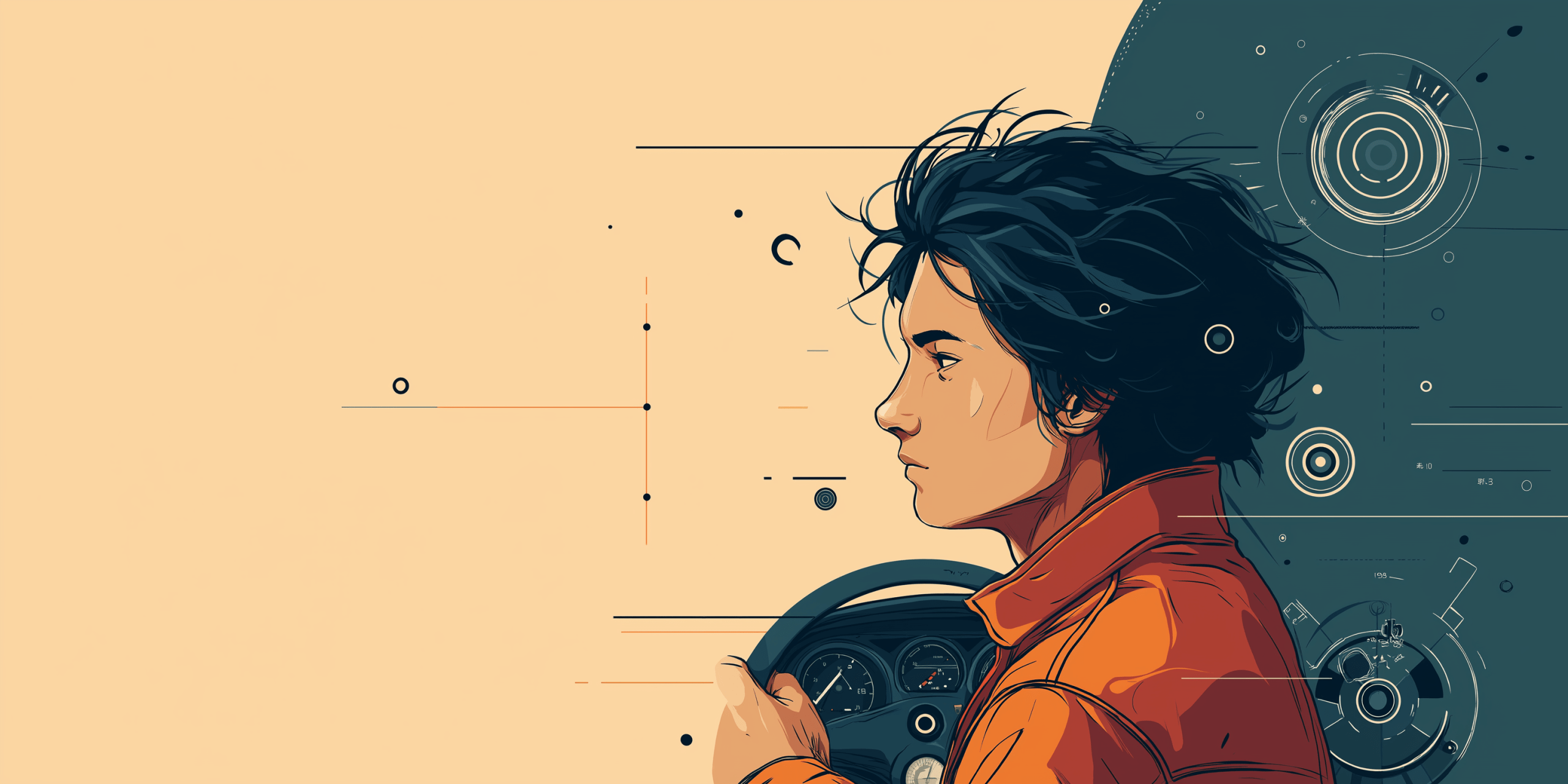
Biology, in general, follows a similar principle. A gazelle doesn’t analyze the biomechanics of a cheetah’s stride; it simply recognizes danger. Similarly, a frog doesn’t calculate the aerodynamics of an insect; it simply recognizes food. Our immune system doesn’t model every molecular interaction occurring within the body; it distinguishes between self and foreign, healthy and infected. Time and again, living systems seem to compress an immense amount of operational complexity into a limited number of meaningful distinctions (signs).
Safe.
Danger.
Hunger.
Healthy.
Threat.
These aren’t just about how things work; they’re about what we think about the world. That got me thinking, are outcomes really just predictions that have become helpful? Most of the time, we’re not even really thinking about how things are happening around us. We’re just living in predictions that seem to work. We expect the stairs to keep going. We expect the road to stay the same. We expect the person we’re talking to to finish what they’re saying.
Only when those predictions fail do we suddenly descend into the machinery.
The missing step.
The strange noise from the engine.
The unexpected silence in a conversation.
Operational thinking is not be our normal mode of cognition. It may be our diagnostic mode. We descend into operations when our predictions are no longer sufficient to explain what is happening.
That observation reminded me of my own field. For the past twenty-five years, I’ve worked in monitoring, diagnostics, observability, cybernetics, and more recently, semiotics. Reflecting on that time, I realized that almost everything we’ve built assumes systems should be represented operationally.
We collect traces.
We collect logs.
We collect metrics.
We reconstruct call graphs.
We record every request, every database query, every state transition, every message exchanged between services. In effect, we’ve tried to represent software almost entirely through its operations. As systems became larger and more distributed, we simply collected more. Every service emits more telemetry. Every platform stores more events.
Every vendor promises that if we capture enough operational detail, understanding will eventually emerge. What we’ve become extraordinarily good at collecting is mechanism.
What we’ve become remarkably poor at representing is outcome.
Of course, every operation has an outcome of its own. A request succeeds. A function returns. A queue accepts another message. But these are outcomes only at the scale of the operation itself. They tell us almost nothing about the outcome of the system. A million successful operations can coexist with a system that is slowly becoming fragile.
The operational world and the situational world are not the same thing.
This feels strangely familiar. Imagine trying to understand the weather by tracking every individual air molecule. Every movement is faithfully recorded. Every interaction is preserved. Nothing has been lost. And yet no one has told you whether tomorrow will be warm, cold or stormy. The molecules matter. But temperature is what we live in.
Modern observability is like this.

We have become exceptionally skilled at recording the molecules while asking operators to infer the weather. During an incident, engineers sit in front of dashboards containing thousands of graphs, millions of log lines and traces stretching across hundreds of services. The system has described almost everything it has done.
The one question people still ask is remarkably simple.
What is actually happening?
That question isn’t about performing another operation; it’s about determining the result or making a decision.
Is the system coping?
Is it recovering?
Is it becoming unstable?
Is coordination beginning to fail?
Is this unusual, or is it dangerous?
Those aren’t operational descriptions; they’re assessments of the situation.
This is where we’ve gone astray.

We’ve confused the language of diagnosis with the language of understanding. Operations are crucial. When something goes wrong, we need to comprehend mechanisms, trace causes, inspect failures, and explain behavior. However, diagnosis isn’t awareness. A doctor doesn’t constantly think in terms of cellular chemistry. A pilot doesn’t fly by monitoring every hydraulic movement. A footballer doesn’t calculate muscle contractions before kicking a ball. Operations are where intelligence takes over when prediction fails. Most of life is lived elsewhere.
The future of observability lies not in collecting an ever-increasing number of operations, but in learning how to represent outcomes. It’s not about replacing diagnostics, but rather recognizing that diagnostics should support awareness rather than replace it. For three decades, we’ve been teaching our systems to describe every action they perform. Now, it’s time to teach them to interpret those descriptions for us.
Appendix A
| Comparative Dimension | Operational World The Mechanism | Situational World The Sign |
| Granularity Scale | Micro Molecules, Traces, Spans, Call Graphs | Macro Weather, Systemic Cohesion, Resilience |
| Cognitive Function | Diagnostic Used to dissect why a failure occurred. | Awareness Used to determine if the system is coping. |
| Variety Level | High Infinite decomposition. | Low Compressed meaningful distinctions. |