The apprentice returned carrying the fourth light.
The master said,
What does it show you?
The apprentice raised it above the city.
Every cart that moves.
Every gate that opens.
Every message that crosses a boundary.
Every call, query, failure, and return.
The master said,
Is the city safe?
The apprentice looked again.
I can tell you what it is doing.
The master said,
I asked what all that doing has become.
The apprentice lowered the light.
I can see its operations.
I cannot yet see its outcome.
The master said,
That is today’s lesson.

The master pointed toward a waterwheel
turning beside the road.
The master said,
Describe what you see.
The apprentice said,
Water presses against the paddles.
The wheel turns.
The axle carries the rotation.
The gears move the millstone.
The master said,
And beneath that?
The apprentice looked more closely.
The force of the water.
The shape of each paddle.
The friction between the gears.
The grain passing beneath the stone.
The master said,
And beneath that?
The apprentice considered the question.
Smaller movements.
Smaller forces.
Smaller interactions.
The master said,
Where does the description end?
The apprentice said,
There is no natural end.
The master nodded.
An operation reveals another operation beneath it.
Every mechanism can be
divided into smaller mechanisms.
Every task can be
divided into subtasks.
Every movement can be
traced to other movements.
Operational detail produces
more operational detail.
The apprentice said,
Then operations explain how something happens.
The master said,
They describe the machinery of happening.
The apprentice said,
And outcomes?
The master pointed toward the mill.
Did the grain become flour?
Did the flour reach the village?
Was it received before winter?
Were the people fed?
The apprentice said,
Those questions do not ask how the wheel turned.
The master said,
They ask what its turning amounted to.
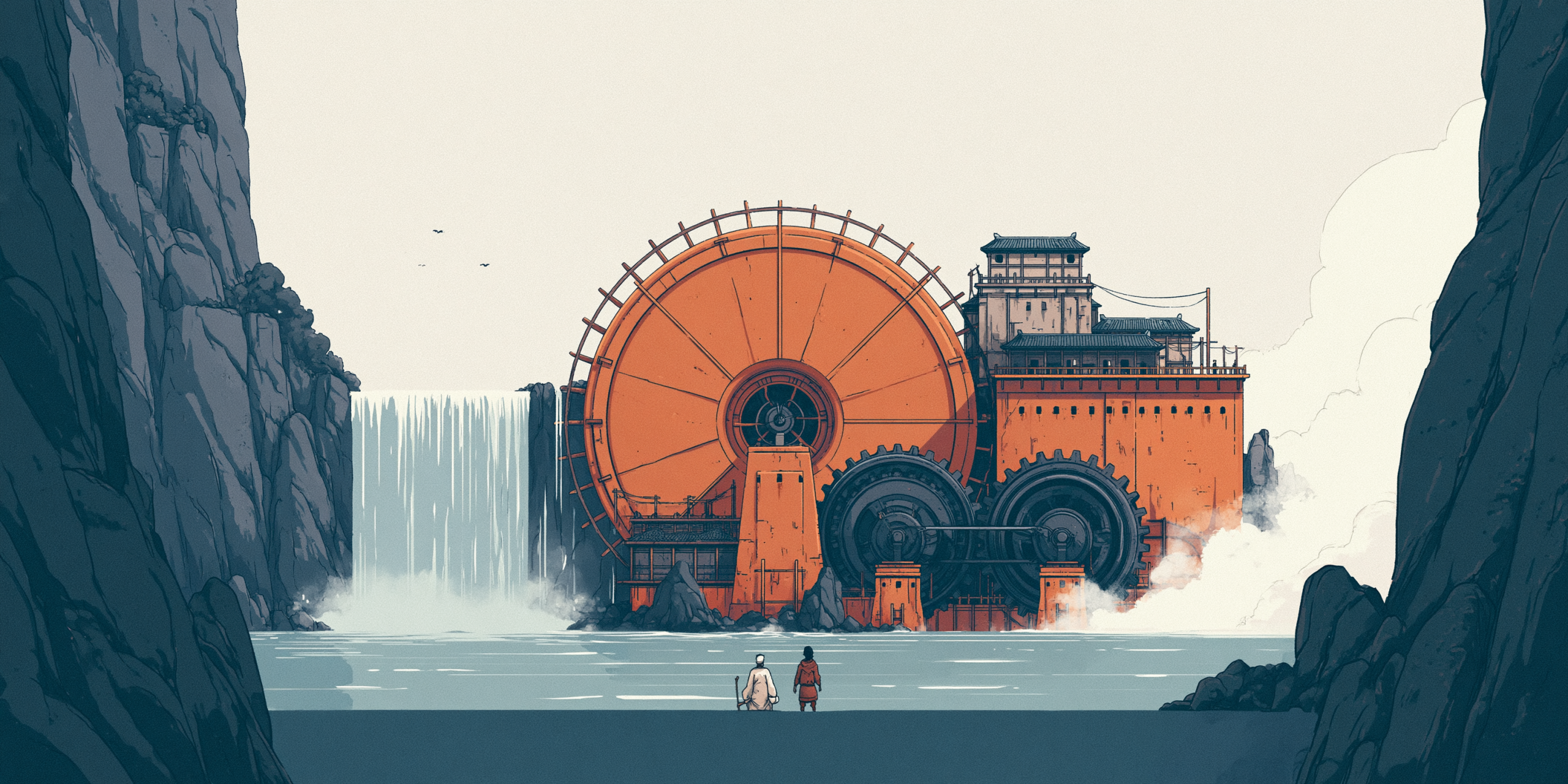
The apprentice watched the wheel.
The water moved.
The paddles turned.
The gears engaged.
Every operation could succeed
while the village remained hungry.
The apprentice said,
Then an outcome is not simply
the completion of an operation.
The master said,
Completion is a result
at the operation’s own boundary.
A request succeeds.
A function returns.
A queue accepts a message.
A service responds.
Each may be called an outcome
when viewed locally.
The apprentice said,
But the boundary can widen.
The request succeeds
while the customer loses their work.
The function returns
while the system becomes less stable.
The queue accepts the message
after the moment in which it mattered.
The service responds
while the larger commitment approaches failure.
The master said,
A million successful operations can coexist
with a system that is slowly becoming fragile.
The apprentice said,
Success at one boundary does not
establish success at another.
The master said,
Whenever someone names an outcome, ask:
Outcome for whom?
Within which boundary?
Against which expectation?
Over what interval?
At what scale?
The apprentice said,
Then outcomes are judgments.
The master said,
They are judgments of consequence.
The apprentice said,
Some will say that makes them subjective.
The master said,
Situated does not mean arbitrary.
The same heat that warms a house
may destroy a crop.
The same delay tolerated by a nightly report
may endanger a control system.
The same failure absorbed by a redundant service
may break a customer commitment elsewhere.
Meaning changes with the subject, boundary,
expectation, and available action.
Without those, there is activity.
With them, activity acquires consequence.

The master began descending an old staircase.
The apprentice followed.
The master said,
Do you calculate the mechanics of every step?
The apprentice said,
No. I expect the next step to be there.
The master stopped before a broken stone.
The apprentice stopped behind him.
The master said,
And now?
The apprentice studied the gap.
Now I want to know what failed.
Was the stone weakened?
Did the support move?
Was the weight too great?
Has the ground shifted?
The master said,
You lived in the expectation
until the expectation failed.
Then you descended into the mechanism.
The apprentice said,
Are outcomes merely predictions, then?
The master turned.
Expectation is the prediction.
Outcome is what came of the action.
The difference between them carries meaning.
The expected step is present,
and you continue.
The expected step is absent,
and the absence becomes a sign.
The apprentice said,
Prediction allows us to move
without examining every operation.
The master said,
Living intelligence survives through such compression.
A gazelle does not calculate the biomechanics
of a cheetah’s stride.
It recognizes danger.
The word compresses countless movements
into a distinction about a possible outcome.
Near or far.
Safe or dangerous.
Approaching or receding.
Escape open or escape closing.
The apprentice said,
Compression is not the loss of intelligence.
The master said,
It is what makes intelligence usable.
Only when the distinction no longer suffices
must the organism descend into detail.

The apprentice looked toward the sky.
Clouds were gathering above the city.
The master said,
Imagine that you could record the movement
of every molecule in the air.
Every collision preserved.
Every change in direction measured.
Every exchange of energy stored.
Would you know whether to bring the boats ashore?
The apprentice said,
Not from the movements alone.
I would need to know whether a storm was forming.
The master said,
The molecules matter.
But temperature is the condition we inhabit.
The storm is the situation taking form.
Safe passage is the outcome we care about.
The apprentice said,
Mechanism, condition, situation, and consequence.
The master said,
Different depths of understanding.
Obsessive record-keeping has become good
at counting the molecules
and remarkably poor at expressing the weather.
The city records every pulse, every movement,
every shift of weight, and every message passed.
When trouble strikes,
the watcher is buried under endless ledgers,
thousands of diagrams, and trails crossing
through countless distant quarters.
The system has described
almost everything that occurred.
Yet the watcher still asks,
What is actually happening?
The apprentice said,
Is the system coping?
Is it recovering?
Is it becoming unstable?
Is coordination beginning to fail?
Is the condition unusual, or dangerous?
The master said,
Those are questions about what the operations have become.
The apprentice lifted the fourth light.
The apprentice said,
The other acts may still remain close to the machinery.
Signal says that a line was crossed.
Search retrieves the operations
surrounding the crossing.
Suggest directs attention toward operations
that may matter.
The master said,
And situate?
The apprentice said,
Situate must reveal what those operations
are doing to the shared field.
Which subject is affected.
Which commitment is weakening.
Which boundary contains the effect.
Which condition is forming.
Which outcome is becoming possible.
The master said,
Then the system requires more than records.
The apprentice said,
It requires distinctions.
The master said,
Distinctions encoded before the moment of inquiry.
Subjects.
Boundaries.
Expectations.
Commitments.
Roles.
Strength.
Confidence.
Direction.
A model of significance through which
occurrences can acquire meaning.
The apprentice said,
An operation produces an event.
Against an expectation,
the event may become a sign.
Signs gather into status.
Status unfolding within context
becomes situation.
Situation reveals the outcomes forming
and the actions still available.
The master said,
Now the machinery speaks of more than itself.

The apprentice looked again at the city.
A gate was receiving every cart,
but the time left to store the harvest was running out.
A distant outpost was answering every caller,
but taking longer with each passing hour.
A new bridge had been completed,
but the surrounding ground
was giving way under the weight.
The operations were successful.
The condition was not.
The apprentice said,
The observability should not merely report
that an operation occurred.
It should express what that occurrence means
for the subjects and commitments that matter.
The master said,
And when explanation is required?
The apprentice said,
We descend into operations.
The master said,
Outcomes do not replace diagnosis.
They give diagnosis purpose.
Awareness tells us which condition matters.
Diagnostics explains the mechanism producing it.
Awareness without diagnostics may recognize
danger without explaining its cause.
Diagnostics without awareness may explain
every mechanism without knowing
which consequence matters.
The apprentice said,
One provides orientation.
The other provides descent.
The master said,
A capable system must support both
without confusing them.
Evening settled over the city.
The apprentice raised the fourth light once more.
The master said,
What do you see now?
The apprentice said,
I see gates opening, carts moving,
messages crossing, and wheels turning.
But I no longer mistake their movement
for understanding.
I see the northern store receiving grain
while the lower village falls behind
its winter commitment.
The transfer succeeds.
The provision fails.
The master said,
Then the light has begun to situate you.
The apprentice said,
Before, I believed its purpose was to make
every operation visible.
Now I see that its purpose is to make
their consequences legible.
The operations did not disappear.
They took their proper place:
evidence beneath a judgment,
available when the judgment demanded explanation.
The apprentice looked across the city.
The fourth light did not reveal another operation.
It revealed what all the operations had become.